
RESTNOVA · Navigate
Napoleon Hill's Definiteness of Purpose: Stop Drifting
The decision that defines your life, and the current that makes it for you when you don’t.
Open this episode on YouTube →
The One Idea
Definiteness of purpose is Napoleon Hill’s first law of achievement: one definite aim, chosen, written, and held. After twenty years studying the lives of those who truly arrived, Hill found that neither talent nor fortune set them apart; the ones who reached their shore were simply the ones who had decided exactly which shore was theirs. The one decision beneath every visible choice is quieter than any dramatic crossroads: whether to steer at all, or to let the current carry you and call the drifting fate.
- Most people never truly decide. They drift downstream, year after year, and call the drifting fate.
- The current is your circumstance. The helm is your life. And the two were never the same thing.
- Not to choose is itself a choice: the one who never takes the helm has granted the river authority over his one and only life.
- One small degree, held to the very end, will land you in another world.
- A heading need not be grand: one fixed point, held a little more faithfully than it was yesterday.
Principle: Navigate (NOVA) · The trap: the drift called openness · The anchor: Napoleon Hill, definiteness of purpose
The Parable, Block by Block
Below is the video’s full narration, exactly as spoken, with a short teaching under each passage: what the image means, where the trap is hiding, and what the moment asks of you.
Block 1 · Slide: The River at Night
The opening frame is an immense dark river basin under a vast star field, the traveler tiny beside a single waiting boat, and a mountain barely visible on the far shore. The narration’s first move is to relocate the defining decision: not at the rare crossroads we agonize over, but in a quiet daily offer. Mark the verb in the last sentence, because it is the episode’s whole diagnosis: the decision is not rejected, which would take courage, but quietly refused, which takes nothing at all. Refusals that cost nothing are the ones that repeat for a lifetime.
Block 2 · Slide: The Drift
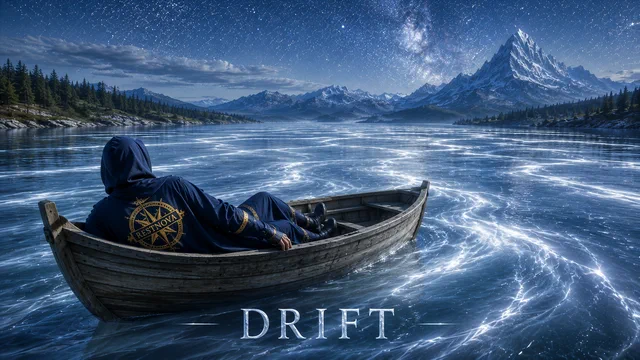
The trap makes its entrance in its signature: a smooth, pale, dispersing silver flow sliding the reclined traveler across the frame, not toward anything, with DRIFT written in that same cool silver. Look closely at what the water is doing, because it is the trap’s whole method: the motion is real, and the progress is not. Drift feels like journey from inside the boat. And notice the narration’s deeper cut: the choice we deliberate over, this path or that one, sits on top of a prior choice almost no one notices they are making, which is whether to have a hand on the helm at all. The last sentence names the trap’s alibi. Fate is what drift calls itself in retrospect.
Block 3 · Slide: The Current of Every Life
The frame widens to many faint boats, all carried the same direction, banks sliding past, no one steering. Read the current’s ingredient list slowly, because none of its threads is sinister: habit, circumstance, other people’s wishes, least resistance. Ordinary forces, each defensible on any given day, weaving together into a direction nobody picked. The block ends by collapsing every possible future into two arrivals that look identical from the outside: the chosen shore and the woken-up-on one. The entire video lives in the difference.
Block 4 · Slide: The Helm
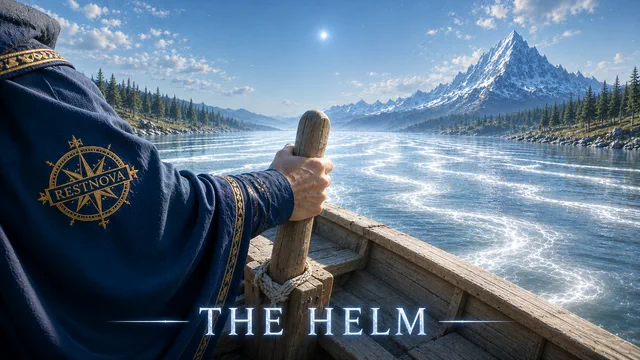
Against the formless silver, the episode sets its quiet true thing: a single worn oar, a steady hand resting on it, one fixed point of light held in frame, with THE HELM in calm blue-white. Study what the helm does not do, because the trap survives on misunderstanding this: it does not fight the current, does not race it, does not stop it. It only holds a heading, and the narration’s claim is that this smallest of all governable things, not the water’s speed, decides the landing. A promise is planted here too: a famous student of great lives proved it, and he waits further down the river. The fixed light above the hand carries the promise until then.
Block 5 · Slide: The Far Shore

The story opens with everything in order: a destination sighted, a boat available, a departure actually made. This traveler’s failure will not be the failure to begin; he pushes off from the land he knew, which is more than many ever do. The parable is precise about where the surrender happens, and it is in the last five words: he let the water take him. Beginning a journey and steering one are different acts, and the space between them is where this whole story lives.
Block 6 · Slide: The Gentle Drift
Here is this episode’s version of the trap’s sentence, and like every one before it, it sounds entirely reasonable in your own voice: I will see where it carries me, and decide once the right way becomes clear. Notice its two working parts. First, it borrows the language of openness and patience, virtues no one can argue with. Second, it sets a condition that will never announce its own arrival: the right way does not become clear to a boat that is turning slowly with the water. Clarity of heading comes from holding one, not from waiting for one. The lazy rotation of the boat in this frame is the sentence, drawn.
Block 7 · Slide: The Delta

The delta is the drift made structural, and it is the frame that answers everyone who believes deferring a choice preserves it. The river is not one river; it forks, and forks again, and every parting passed without a hand on the helm is a decision that got made anyway, by the water. Mark the terrible gentleness of the language: he slipped quietly down a channel he never meant to take. Unchosen lives are not seized. They are slipped into, one unattended parting at a time, each one so smooth it never registers as the turning point it was.
Block 8 · Slide: The Other Drifters
The frame fills with overlaid boats, seasons hinted at the banks in falling leaves and thin frost, and everyone reclined. The sentence to sit with is the one inside every drifter’s head: certain they would take the helm before it truly mattered. That clause assumes the mattering will announce itself, that some parting will arrive labeled as the important one. But the delta has already shown the truth: the partings all look alike, and they were all mattering. There is no future moment when steering begins to count. It was counting from the first bend.
Block 9 · Slide: The Boatwoman
The mentor arrives, and the composition teaches before she speaks a word. She is not rowing and not hurried; her advantage over the wandering boats is visibly not effort. It is a heading. Her craft cuts a clean diagonal across the same current that scatters everyone else, which quietly proves the episode’s physics: the current is identical for all of them, so the difference must live in the one thing she has and they lack. And her eyes are fixed on something he cannot yet see, which is exactly right. A chosen star is invisible to a man who has never looked up to choose one.
Block 10 · Slide: One Star
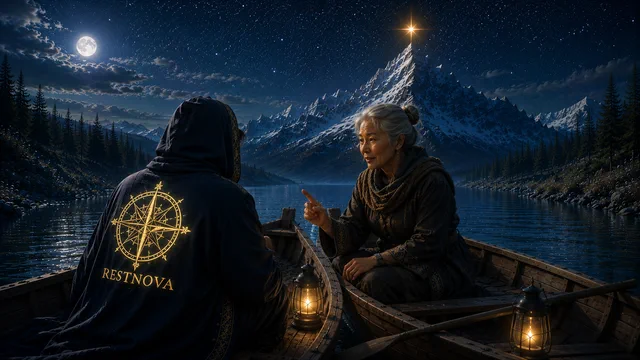
The mentor’s lesson, and its first mercy is the same one every RESTNOVA mentor grants: she cancels the impossible task. The river was never yours to stop; stop trying to be stronger than water. What remains is the one governable thing, and her middle sentence is the hinge of the whole episode: a current you do not steer is a decision you have handed to the water. Not a postponed decision. A made one, with the river as your proxy. And watch the sky as the rudder turns: one star among the cold scattered points kindles into true gold, ONE STAR written in its warmth, the first real warmth of the film. The gold does not exist until the choosing does. In this episode, that is the law: heading is what lights the star.
Block 11 · Slide: He Turns the Rudder

His objection is the honest one, and the parable lets him almost say it: one oar against all that water. What moves him past it is not faith but a ledger, the same exhausted arithmetic that moves most real people: years of drifting, and not one arrival he had chosen. Then notice what the turn actually delivers, because the narration refuses to inflate it. The boat does not leap. Nothing accelerates. The entire victory of this block is a change of state, not of speed: aligned instead of carried. Every transformation in this series begins with exactly this kind of non-event, and the people waiting to feel momentum before they steer have the order backwards.
Block 12 · Slide: The Heading Holds
The compounding block, and its image is a single clean, gold-touched wake cutting diagonally across the formless silver while the unsteered boats slide past downstream. The narration is honest about the interior experience: no single hour felt like much, the star seemed no nearer. Feeling is a bad witness to accumulating degrees, just as it is to every slow-built thing. The metaphor doing the deepest work here is the river gathering from a thousand hidden streams: the same structure that made the current so powerful is now working for him. Small inputs, patiently summed, are not the weak version of change. They are how rivers are made.
Block 13 · Slide: Current and Helm
The principle, stated plainly, over a balanced frame that honors the current’s power on one side and the small steady hand on the other. This block performs the separation the whole culture blurs: circumstance and life, current and helm, treated everywhere as one thing, so that people with hard currents conclude they have no life to steer. The parable refuses the merger. Mastery of the water is given to no one, which means it was never the measure of anyone. The final three sentences are the episode compressed to its atoms, and they are the ones to carry out if you carry nothing else.
Block 14 · Slide: The Unsteered Boat
The hardest block in the episode, and the image matches it: a single empty boat carried down a dark channel toward a cold, featureless sea, no hand at the helm anywhere. The narration names precisely what the drifting heart tells itself it is doing, keeping options open, and then names what it is actually doing: signing a power of attorney over to moving water. The closing clause is the coldest sentence in the film and the truest. The river holds no care. Circumstance is not malicious; it is indifferent, which is worse, because indifference cannot even be appealed to. Whatever you have not chosen to steer is being steered by something that never once thought of you.
Block 15 · Slide: The Student of Great Lives
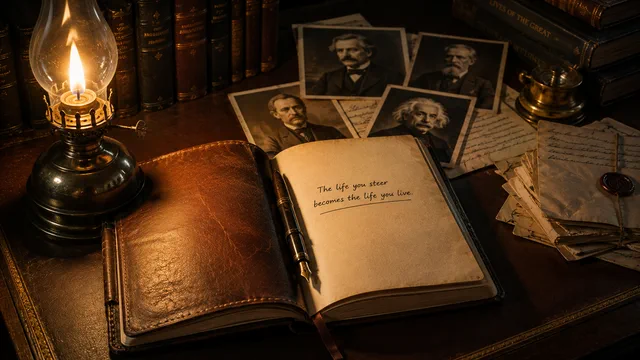
The promised student of great lives arrives, and the parable pauses in a lamplit study from early last century: a worn leather journal open beside a low brass lamp, a fountain pen in its crease, a stack of letters and portraits of the accomplished with their faces half in shadow, and on the open page one line written and underscored. Napoleon Hill spent two decades interviewing and studying the builders and arrivers of his age, and the law he placed before all others is rendered here in close and faithful paraphrase, not invented quotation: definiteness of purpose, one definite aim, chosen, written, and held. Every word of that formula is load-bearing, and written most of all; Hill taught that an aim left unwritten stays a mood, and a mood cannot be steered by. Notice too what his conclusion eliminated: talent and fortune, the two alibis every drifting heart reaches for first. The lamplight’s restrained antique amber is deliberately neither the drift’s dispersing silver nor the star’s true gold; it is the register this series reserves for inherited wisdom, the light of the lineage itself. The underscored line and the chosen star are the same object, a century apart.
Block 16 · Slide: Navigate
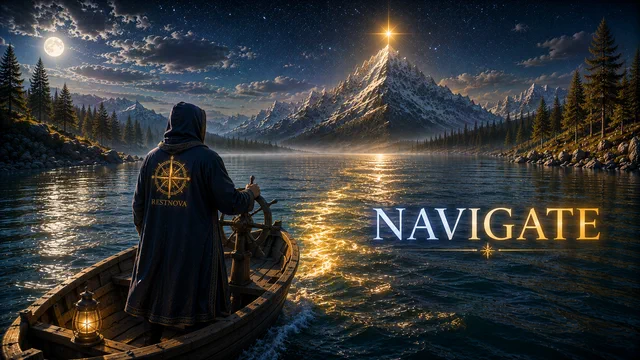
The episode’s principle takes its place, and with it something larger turns: NAVIGATE, written in blue-white warming toward gold, is the first of the outward works. The narration marks the threshold plainly: the inner work of reflection, honest evaluation, and simplifying can all be complete, and a life can still sit at anchor, because becoming someone and steering somewhere are different labors. This is the pivot from who you become to what you create, and the camera makes it physical, pushing forward past the traveler for the first time, up the line of his heading toward the star and the peak. Everything before this block faced inward. Everything after it moves.
Block 17 · Slide: The Single Heading
This block protects the teaching from the objection that stops most people at the water’s edge: that choosing a purpose means authoring a life plan, a map of the whole sea. The narration strips the requirement down to something almost embarrassingly small: one fixed point, held slightly more faithfully than yesterday. The image performs the selection test worth stealing for your own sky: among many faint scattered stars, one holds and the rest gently dim. And note the criterion for the choice: not the most impressive star, but the one you can still steer by when the night is dark and the current is strong. A purpose that only works in fair weather is one of the smaller lights. Let it go.
Block 18 · Slide: Your Own River
The frame empties into stillness: a boat resting at a quiet bank, an oar laid ready across it, a place left open for you to step in. The search instruction is exact, so use its exactness. You are not hunting for laziness or failure; you are hunting for the word openness doing work it was never meant to do, the direction perpetually about to be chosen, the heading on permanent loan to the current. Everyone has at least one such water. The block’s final demand is the productive one: name the shore. Not the plan, not the route. Just the shore, said out loud, as if the choosing were truly yours. It is.
Block 19 · Slide: Steer

STEER, written in blue-white as a hand closes around the oar and the bow shifts a few degrees toward the distant gold star. The practice is deliberately undersized, and the framing sentence explains why: the whole crossing is not today’s assignment, only the next small turn. Then the block quietly relocates where life’s defining decision actually lives. Not in the grand shining moment the culture keeps promising, but in a turning of the helm so small it can be repeated on any ordinary day, again and again and again. The repetition in that final phrase is not rhetorical decoration. It is the mechanism.
Block 20 · Slide: The Turning Bow

Mark what the parable calls brave, because it keeps redefining the word on purpose: not a battle with the current, but sitting up. Taking the oar. A posture change, performed on an ordinary morning with no occasion attached. That is the simplest and bravest thing a drifting life can do precisely because drift’s whole power is the promise of a better morning to do it on. And where the river meets the far shore, the series’ signature threshold opens: dawn breaking like an arch of gold, with the chosen channel running straight and shining beneath it. The arch appears only over the channel he chose. Unchosen channels end at featureless seas; chosen ones end at thresholds.
Block 21 · Slide: Arrive
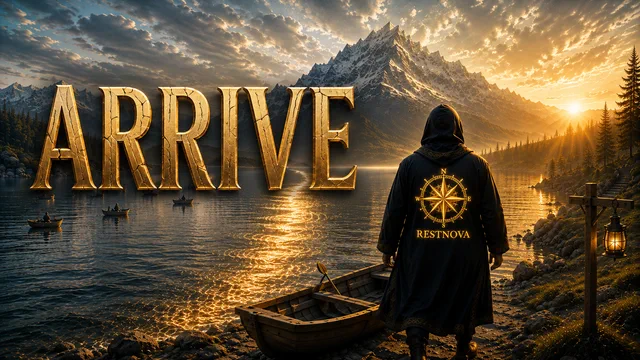
The final frame pulls back to reveal the whole crossing: the traveler stepping onto the far shore at the mountain’s foot, ARRIVE in gold, and behind him his wake glowing gold all the way back across the water to the blue delta where the unsteered boats still drift. Both endings visible in one image, joined by nothing but a held heading. The closing address is built on the episode’s most practical distinction: the life you love is not delivered by strong days or shining moments but by the heading held on ordinary days, the ones when drifting would be easier. The closing question is the video’s assignment, restated as a prompt below. Answer it before the day’s gentle pull resumes, because it will.
About Napoleon Hill and Definiteness of Purpose
Napoleon Hill (1883–1970) was an American writer who spent roughly twenty years studying, interviewing, and corresponding with the most accomplished builders of his era, distilling what he found into a philosophy of achievement that shaped a century of personal-development writing after him. His conclusions appeared first in The Law of Success (1928) and reached their most famous form in Think and Grow Rich (1937), one of the best-selling books ever written on the subject of accomplishment.
Standing first among his principles is the one this video’s anchor block carries: definiteness of purpose, a single definite aim, chosen, written, and held. Hill’s claim was pointedly not that the successful were the most talented or the most fortunate people he studied; it was that they were the decided ones, the men and women who knew exactly which shore was theirs and organized their days around reaching it. He was insistent on the writing: an aim committed to paper, returned to daily, was in his teaching the difference between a purpose and a passing wish. The drifting majority, in his account, did not lack ability. They lacked a heading.
The video paraphrases Hill faithfully rather than quoting him, compressing his first principle into the parable’s own vocabulary of stars, helms, and shores, with no invented quotations. The parable of the river and the boatwoman is original to RESTNOVA; Hill supplies its law. He would have recognized the delta instantly, and the empty boat too. He spent twenty years asking arrived men and women what separated them from the carried ones, and their answers kept pointing at the same quiet thing: a hand on the helm, and one star chosen above the rest.
Questions to Sit With
The traveler drifted for years past questions he never let himself hear. The video leaves you with the quiet kind that decides a life. Taken together, they make a short evening’s journaling, best done before the day’s gentle pull resumes.
- Where is the current carrying you, and have you ever once chosen the shore?
- Where have you been drifting and calling it openness: the direction you keep meaning to choose, the heading quietly left to the current?
- Name the shore you would reach if the choosing were truly yours. Write it down, exactly, as Hill taught.
- What is the next small turn of the helm, not the whole crossing, you could make today?
Frequently Asked Questions
What is definiteness of purpose?
Definiteness of purpose is Napoleon Hill’s name for the first law he found in the lives of high achievers: one definite aim, chosen, written, and held. After twenty years of study he concluded that neither talent nor fortune separated those who arrived; the ones who reached their shore were simply the ones who had decided exactly which shore was theirs.
What is the decision that defines your life?
The decision that defines your life is not made once at a dramatic crossroads. It is the daily decision to steer toward a chosen star rather than be carried by a current you never chose: habit, circumstance, other people’s wishes, the pull of least resistance. That current will carry you somewhere either way. Steering is what makes the somewhere yours.
Is not deciding really a decision?
Yes. Not to choose is itself a choice, because the current keeps moving whether or not you take the helm. The person who never decides has not kept their options open; they have granted authority over their one life to circumstance, and circumstance holds no care for where they once longed to go. Deferring the decision is making it, invisibly.
How do I choose one definite purpose?
Start smaller than a life plan: choose one fixed point you can steer by when the night is dark and the current is strong. Name the shore you would reach if the choosing were truly yours, write it down as Hill taught, and hold it a little more faithfully than yesterday. Let the smaller, scattered lights gently go.
What does “the current is your circumstance; the helm is your life” mean?
It means your circumstances and your life are not the same thing. The current, everything that carries you, cannot be stopped, and mastering it was never the task; that power is given to no one. The helm is the one small thing you can govern: your heading. To decide is to choose a heading and hold it through water you never could control.
What is the RESTNOVA framework?
RESTNOVA is an eight-part framework for transformation in two halves. REST (Reflect, Evaluate, Simplify, Transform) is the inner work: who you become. NOVA (Navigate, Optimize, Visualize, Achieve) is the outer work: what you create. The order matters: personal transformation comes first, and meaningful achievement grows out of it.
Every RESTNOVA video stands alone, and together they follow one traveler through the eight works of REST and NOVA.
Navigate is the first work of NOVA. The full framework is here.
RestReflect · Evaluate · Simplify · Transform
NovaNavigate · Optimize · Visualize · Achieve