
RESTNOVA · Transform
Aristotle on Habit: Stop Waiting for Motivation
The habit that changes everything, and the loud guest we keep mistaking for it.
Open this episode on YouTube → Or experience it as a guided meditation →
The One Idea
Aristotle was right: character is built by repetition, not by feeling. You do not transform through bursts of motivation; you transform through one small action, repeated faithfully, until it stops being something you do and becomes someone you are. And the famous line itself carries a surprise the video names honestly: the words were written by the historian Will Durant, summing Aristotle up, and the summary is faithful to the source.
- Motivation is a guest. It arrives loud, promises much, and is gone by morning. Habit does not roar; it returns.
- You do not change your life by the force of a great effort, but by the faithfulness of a small one.
- Every repetition is a vote, cast in silence, for the self you are becoming.
- We do not rise to our hopes. We fall to our habits.
- Make the stone small enough to survive your worst days, for it is the worst days, not the best, that decide who you become.
Principle: Transform (REST) · The trap: the flare of motivation · The anchor: Aristotle on habit, through Will Durant’s famous line
The Parable, Block by Block
Below is the video’s full narration, exactly as spoken, with a short teaching under each passage: what the image means, where the trap is hiding, and what the moment asks of you.
Block 1 · Slide: The Mountain Too Vast
The frame opens on the problem at full scale: a tiny hooded figure beneath an immense, sheer, pathless mountain, its summit swallowed in cloud. No road is visible anywhere, which is exactly how a life-sized change looks from its foot. The narration plants the episode’s central irony in its second sentence: the remedy is overlooked because it is small. We are trained to weigh things by what they demand, so the act that asks almost nothing gets valued at almost nothing. The parable exists to correct the scale.
Block 2 · Slide: The Surge That Fades
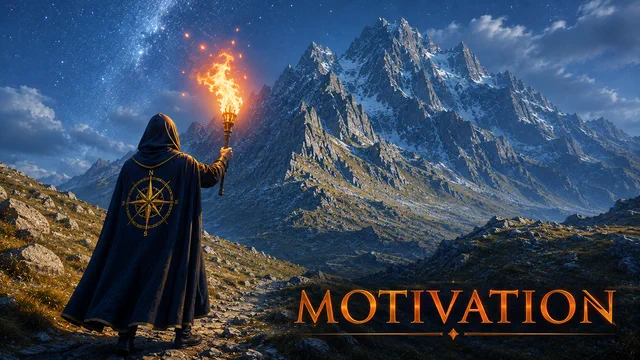
The episode’s trap makes its entrance in its own signature light: a torch flaring hot orange against the cold blue night, bright, fierce, and already flickering thin at the edges. MOTIVATION appears in that same hot orange, at the exact moment its light begins to gutter. That is the whole trap in one composition: the word at its brightest is already dying. And mark the final sentence, because it is where the real damage happens. The surge leaving is a law of surges. We read it as a verdict on ourselves.
Block 3 · Slide: When the Fire Leaves
The flare has died to a single thin red ember, and the mountain behind it stands entirely untouched. The guest metaphor deserves to be taken literally: no one builds a house on a visitor, yet nearly everyone builds their hope of change on one. The indictment in the last sentence is structural, not moral. Nothing is wrong with the person trusting; something is wrong with what was trusted. Feelings are, by nature, the least permanent residents of a self.
Block 4 · Slide: The Quieter Thing

Beside the guttered flare, a second light appears: small, cool, unflickering. Calm where the flare was frantic. HABIT, written in that steady blue-white. The two lights side by side are the episode’s entire argument rendered visible, and the narration gives habit the shortest and best definition it will ever get: it does not roar, it returns. Returning is the whole power. A promise is planted here as well: the oldest philosophers knew this law, and the one who named it first will be heard once the story has done its work. The steady light carries the promise until then.
Block 5 · Slide: The Mountain He Chose

The story opens with the traveler’s head tilted all the way back, the scale dwarfing him utterly. Notice that his question is honest and, on its own terms, unanswerable: one man, one short life, against that. The parable will not answer it by making the man stronger or the mountain smaller. It will answer it by changing the verb, though neither he nor the viewer knows that yet. Every real transformation begins at exactly this sunk-hearted moment, staring up at something too vast for the self currently doing the staring.
Block 6 · Slide: The Heroic Rush

The flare returns, now as a method: the traveler climbing furiously by torch-light, all force, all fire, all will. Be fair to him, as the narration is. This is what bold men do, and boldness is not a vice. The culture has one story for mountains, the heroic rush, and he is performing it faithfully. The parable’s quarrel is not with his courage. It is with the physics: a burst, by definition, has an end, and the mountain does not.
Block 7 · Slide: The Fall Back
Cold grey dawn, the torch guttered to ash, the traveler slumped at the very foot of the slope he began from. Two details in the narration deserve separate grief. First, the shame: he treats a failure of method as a failure of character, exactly as Block 2 warned. Second, and worse, what he does with his rest. He does not rest to recover; he rests to wait for the fire, which means the next attempt is already doomed in the same way. The cycle is now closed, and he is inside it.
Block 8 · Slide: The Cycle of Seasons
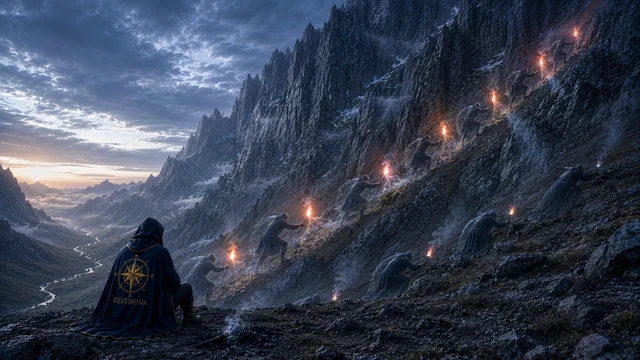
The slide overlays the years into one image: faint repeated figures tracing the same arc, surge up, fall down, while small flares flicker and die along the slope and the mountain stands wholly unchanged through all of it. Sit with the arithmetic of the final sentence, because it is the trap’s cruelest ledger: strength for a hundred climbs, spent honestly, and a total altitude of zero. Effort was never the missing quantity. A hundred bursts do not add; each one starts from the bottom. Only what compounds can climb.
Block 9 · Slide: The Old Woman and Her Stone
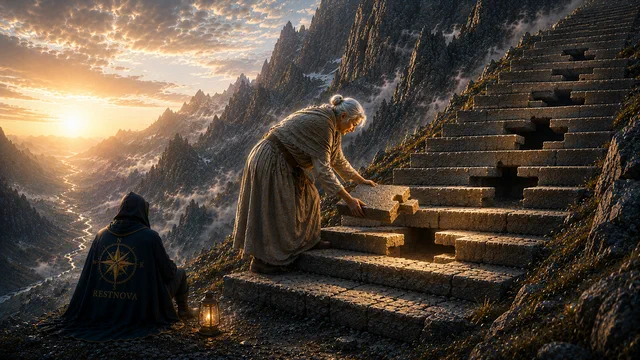
The mentor arrives carrying almost nothing, which is the point. Two details carry the teaching. First, the faint line of stones he had never even noticed: her path was being built in plain sight all along, invisible to a man scanning the slope for routes worthy of a hero. The quiet method is always already there, overlooked for its smallness, exactly as Block 1 promised. Second, she walks back down. Her method includes the descent, the ordinary evening, the return home. Tomorrow, I will lay another: five words that contain the entire remainder of the video.
Block 10 · Slide: Lay One Stone
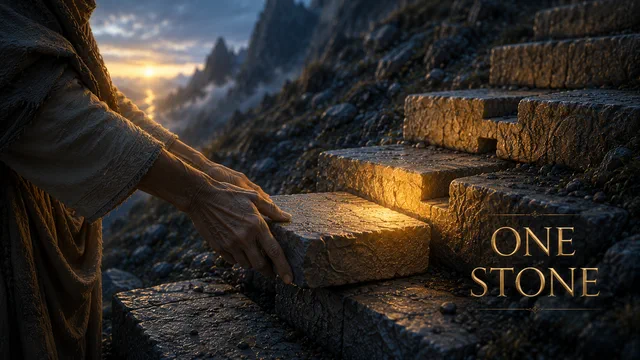
The mentor’s lesson, and its opening sentence performs a mercy the traveler has needed for years: it dismisses the impossible task he assigned himself. You were never asked to. Half of every stuck life is an unpayable demand nobody actually issued. Then the reframe, the episode’s hinge: do not climb the mountain, build the path. Climbing is a contest between your strength and the slope, and the slope always wins. Building removes the contest entirely. And watch the light: the first true gold of the film touches the laid stone, with ONE STONE written in it. Gold, in this episode, belongs to the act, never the feeling. The flare could not make this color.
Block 11 · Slide: Nothing, and Yet

His almost-laugh is the correct first response; the honest scale of one stone against a mountain is absurd, and the parable does not pretend otherwise. What gets him to bend anyway is not faith but an exhausted ledger: everything larger had failed. Then the three most important words in the block, easy to miss: feeling nothing in particular. His first stone is laid without the flare, and that absence is precisely what makes it the true beginning. And notice the shape of the first victory. It is not a gain; it is the absence of a loss. He had not slid back. Compounding always starts this quietly.
Block 12 · Slide: The Path Rising

The compounding, made visible: the warm gold stair winding up into the cloud, each stone faint on its own, the whole path glowing. The middle sentence is the one to underline: no single morning ever felt like much. Feeling is a terrible witness to compounding; it reports each day’s deposit as negligible and never sees the balance. This is why lives built on feeling abandon their stairs three stones in. The river does not consult the drops.
Block 13 · Slide: Faithful, Not Fierce
The lesson, stated plainly, over the calmest image in the episode: steady hands laying a stone at dawn, no flare, no strain. Read the mechanism in the second half carefully, because it inverts the usual math. The small act wins because it is small. Its modesty is not a compromise; it is the engineering. A demand light enough for every ordinary day is the only kind that survives enough days to compound. Force impresses. Faithfulness accumulates.
Block 14 · Slide: Becoming the One Who Lays It

Here the episode reveals its deepest layer, and the image doubles to carry it: over the man bent at his stone, a second self takes shape in strengthening gold, the person the habit is building, growing more solid with each repetition. This series has used the doubled figure before to show a self dissolving through neglect; here the same image runs in reverse, a self forming through faithfulness. The vote metaphor rewards a moment’s thought: votes are small, silent, and individually meaningless, and they are also the only thing that ever decides an election. The stone was never really about the path. It was the ballot.
Block 15 · Slide: The Philosopher’s Tablet
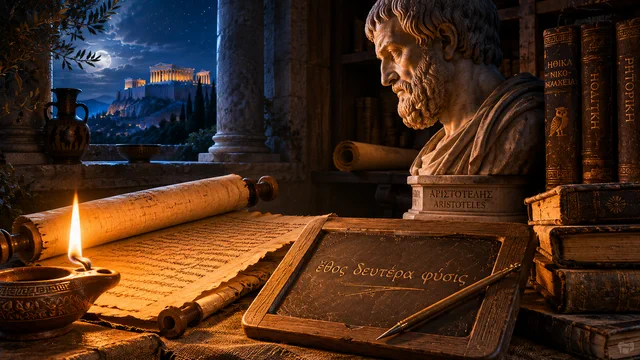
The promised philosopher arrives, and this anchor carries a correction the episode treats as part of the teaching. The line the world quotes, that we are what we repeatedly do, does not appear in Aristotle’s surviving works. It was written by the historian Will Durant in his 1926 book The Story of Philosophy, condensing Aristotle’s ethics into a sentence, and the video names the true author on principle: honesty about sources is not a footnote in a channel about honest self-examination. What matters is that Durant summarized faithfully. Aristotle’s own teaching, developed in his ethics, is precisely this: excellence is never a single act but a settled disposition, built by habituation, the way a craft is learned by practicing it. The paraphrase on screen is faithful to that source. Look at the slide: an oil lamp, a scroll, and a wax tablet bearing one line of Greek, worn as if traced many times over. Repetition itself, inscribed. The restrained antique lamplight is deliberately neither the episode’s hot flare nor the path’s true gold; it is the register this series reserves for inherited wisdom, the light of the lineage.
Block 16 · Slide: Transform

The episode’s work takes its place in the REST sequence: TRANSFORM, written in blue-white warming toward gold as the camera climbs the built stair past the changed figure. Every word of the definition is a demotion of drama and a promotion of repetition, and the final couplet is the keystone line of the whole episode. Hopes are where we look; habits are where we land. The word fall is exact: no willpower is involved in the landing. Whatever you have repeated is the floor that catches you, which means building the floor is the only leverage a life really has.
Block 17 · Slide: The Keystone

The image singles out one stone in the long stair, glowing brighter than the rest, a dozen fainter stones lit by its light. This block saves the teaching from a common failure: the reformed enthusiast who tries to lay twelve stones a day and is back at the flare within a fortnight. The instruction is singular on purpose. Find the key habit, the one whose steadiness makes the others cheap, and begin there alone. Architecture, not ambition: a keystone is not the biggest stone in the arch, only the one holding the others up.
Block 18 · Slide: Your Own Mountain
The frame empties: a bare slope under cold light, and a single stone waiting on the ground to be lifted. A place left open for you to stand. Notice which question the narration calls braver, because it inverts the usual courage. Asking for strength to conquer everything at once feels bold and is actually a postponement; the grand question can be asked forever without a single act. The small question is the brave one precisely because it can be answered before nightfall, and an answered question demands a laid stone.
Block 19 · Slide: Make It Small
SMALL, written in blue-white over a stone resting in an open palm, the vast peak blurred behind it. The design principle here is the most practical sentence in the episode: build for your worst days. Most practices are sized for the best day and are therefore already broken; the first bad morning ends them, and the shame of the ending outlasts the practice. The test in the third sentence is worth keeping as a permanent instrument: if it survives only when inspired, it is not yet a habit, merely a mood wearing one’s clothes. The stone that counts is the one liftable at your weakest.
Block 20 · Slide: The Thousandth Stone

The resolution deliberately repeats the texture of Block 11: an ordinary morning, no fire, nothing in particular. The thousandth stone is laid exactly like the first, which is the whole doctrine in a single gesture. And then the parable’s finest touch: the summit arrives as a surprise, discovered mid-habit, in the act of straightening up from the work. He was not watching the peak; he was laying the stone. Behind it, the first true dawn breaks open like an arch of light, the series’ signature threshold, earned here not by a leap but by a thousand identical bends of the back.
Block 21 · Slide: Become

The reverse shot earns the episode’s last word: the traveler small at the summit, and below him the whole golden stair winding down into the blue valley where the dead flares once flickered and died. Both lights in one frame, the trap’s ashes and the habit’s architecture, with BECOME written in gold above them. The closing question ends on the episode’s deepest turn: the path becomes you. The stone was identity all along. It is restated as a prompt below; answer it today, on an ordinary morning, feeling nothing in particular. That is the correct weather for beginning.
About Aristotle, Habit, and the Line He Never Wrote
Aristotle (384–322 BC) was a Greek philosopher, student of Plato, tutor of Alexander, and founder of the Lyceum in Athens; his surviving works range across logic, biology, politics, and poetry, and his ethical writings remain among the most practical accounts of character ever composed. At their center is a simple, demanding claim: moral excellence is not a gift of nature and not a single fine act. It is a settled disposition, built by habituation, the way a craft is learned. We become just by doing just acts, temperate by doing temperate ones, brave by doing brave ones. Character, in his account, is repetition that has hardened into a self.
The famous modern line, that we are what we repeatedly do and that excellence is therefore a habit rather than an act, does not appear in Aristotle’s works. It was written by the historian Will Durant in The Story of Philosophy (1926), where Durant was summarizing Aristotle’s ethics in his own words. The internet reassigned the sentence to Aristotle, as the internet does. The video names the true author inside the narration itself, because on this channel the correction is part of the teaching: a series built on honest self-examination does not get to be careless about sources. What makes this misattribution unusual, and worth teaching rather than merely debunking, is that Durant’s summary is faithful. The words are his; the law is Aristotle’s.
The video paraphrases rather than quotes throughout, staying close to Aristotle’s actual doctrine of habituation while letting the parable of the stone-laid path carry it. The parable is original to RESTNOVA; the philosopher supplies its law. Aristotle would have recognized the old woman’s method immediately. He spent a career insisting that the excellent life is not a heroic rush but a practice, and that we are built, day by day, out of what we return to.
Questions to Sit With
The traveler lost seasons to a question too large to answer. The video leaves you with the smaller, braver kind. Taken together, they make a short evening’s journaling, best done on an ordinary day, feeling nothing in particular.
- What is the single stone you could lay today, and again tomorrow, small enough that you cannot fail to lift it?
- Where have you been waiting for the surge: blaming your weakness each time the fire leaves, instead of building the thing that does not need it?
- Which of your habits is the keystone, the one act that, standing steady, would make a dozen others possible?
- What would your practice look like if it were designed for your worst days rather than your best? What survives the morning you feel nothing at all?
Frequently Asked Questions
Did Aristotle really say “We are what we repeatedly do”?
No, not in those words. The famous line, with excellence declared a habit rather than an act, was written by the historian Will Durant in his 1926 book The Story of Philosophy, where he was summarizing Aristotle. The summary is faithful to the source: Aristotle taught that moral excellence is a settled way of being, built one repetition at a time. Durant’s words; Aristotle’s law.
What did Aristotle teach about habit?
Aristotle taught that excellence is never a single act but a habit: a settled disposition built by habituation, the way a craft is learned by practicing it. We become just by doing just acts and brave by doing brave ones. Character, in his account, is repetition that has hardened into a self, which is why what you repeat matters more than what you intend.
Why doesn’t motivation last?
Motivation doesn’t last because it is a feeling, and feelings come and go like weather. It arrives loud, promises much, and is gone by morning; the surge always comes, and it always leaves. A life built on its visits stalls every time it departs. Habit is the quieter, stronger thing: it does not roar, it returns, whether the fire is in you or not.
How do I build a habit that actually sticks?
Make it small, almost embarrassingly small: small enough to survive your worst days, because the worst days decide who you become. Choose an act you can repeat when you feel nothing at all, return to it at the same hour, and judge it by whether you returned, not by how it felt. A practice you keep only when inspired is not yet a habit.
What is a keystone habit?
A keystone habit is the one habit that holds up the rest: a single act that, once it stands steady, makes a dozen others possible. In the parable it is the one stone in the stair that glows brightest, with the others lit by its light. Find yours and begin there alone; when it holds, everything else begins to move.
What is the RESTNOVA framework?
RESTNOVA is an eight-part framework for transformation in two halves. REST (Reflect, Evaluate, Simplify, Transform) is the inner work: who you become. NOVA (Navigate, Optimize, Visualize, Achieve) is the outer work: what you create. The order matters: personal transformation comes first, and meaningful achievement grows out of it.
Every RESTNOVA video stands alone, and together they follow one traveler through the eight works of REST and NOVA.
Transform is the fourth work of REST. The full framework is here.
RestReflect · Evaluate · Simplify · Transform
NovaNavigate · Optimize · Visualize · Achieve